
Cider history
From the wild apple forests of Kazakhstan to a Somerset orchard: how the apple travelled west, and how Britain learned to make cider from it. Where the evidence is thin, we say so.
- 1. Tian Shan mountainsc. 4,000–10,000 years ago
Wild apple forests near Almaty in Kazakhstan, home of Malus sieversii, the main ancestor of the domestic apple.
- 2. Judean desert10th century BC
Apple cores found here are some of the earliest direct evidence of apples being eaten well west of Central Asia.
- 3. Athens, Greece5th century BC
Earliest clear written reference to grafting, the technique that let good apple varieties be reliably propagated.
- 4. Rome, Italy160 BC – AD 77
Roman writers from Cato to Pliny record dozens of named, deliberately grafted apple varieties.
- 5. Vindolanda, Hadrian's Wall1st–2nd century AD
A Roman fort on Britain's northern frontier, where a supply tablet requests good apples for the garrison.
- 6. Rouen, Normandy11th century
Norman orchards and the French word 'cidre' fed into England's own cider culture after 1066.
- 7. Holme Lacy, Herefordshire1630s–1660s
Lord Scudamore's Redstreak orchards mark the high point of England's 17th-century cider golden age.
- 8. Long Ashton, Somerset1903
The National Fruit and Cider Institute brought modern science to bear on cider apples and their varieties.
Origins
- 4,000 to 10,000 years ago
The apple's wild ancestor in the Tian ShanEstablished
The cultivated apple descends mainly from Malus sieversii, a wild apple still found on the forested slopes of the Tian Shan mountains near Almaty in south-eastern Kazakhstan. Genetic studies show only the population on the western side of the range contributed to today's apples; an isolated eastern population in Xinjiang did not. Selection for larger, sweeter fruit is thought to have unfolded gradually over roughly 4,000 to 10,000 years, rather than at any single moment.
The exact date domestication began is not fixed; estimates from genetics and archaeology give a wide range rather than a precise year.
- c. 6570–5684 BC
Early apple seeds in ItalyEstablished
Charred apple seeds from the Neolithic site of Sammardenchia-Cueis in north-east Italy have been radiocarbon dated to between about 6570 and 5684 BC, among the earliest apple remains found anywhere in Europe. These seeds most likely came from wild apples rather than a domesticated crop, since true domestication of Malus was still under way further east. They are best read as evidence that people across Eurasia were gathering wild apples long before anyone was grafting or breeding them.
The dating of the seeds is solid, but whether the fruit was wild or an early domesticate is not fully settled.
The long journey west
- Bronze Age to Iron Age (c. 1500–100 BC)
Seeds move west along ancient trade routesLikely
As the trade networks later called the Silk Road grew up across Central Asia, apple seeds and grafted stock travelled with them, picking up genes from other wild crab apples in Siberia, the Caucasus and Europe along the way. Historians and geneticists suggest wild horses, first domesticated in the same part of Kazakhstan, and bears feeding on fallen fruit both helped disperse seeds over long distances even before people were consciously carrying them. Because this was a slow diffusion through many hands and generations rather than one journey, no firm date can be put on when apples reached any particular region.
The role of horses and bears in seed dispersal is a reasonable inference from ecology and geography rather than something directly recorded, and the pace and route of the westward spread are not precisely dated.
- 10th century BC
Apple cores in the Judean desertEstablished
Actual apple cores, rather than just pips, have been recovered from a site in the Judean desert between the Sinai and the Negev and dated to around the 10th century BC. This is some of the clearest direct evidence that apples were already being eaten well to the west of Central Asia by the early Iron Age. It sits alongside indirect textual and archaeological hints of apple cultivation in the Middle East from as early as the third millennium BC.
- 5th century BC (attested by 424 BC)
Grafting first shows up in writingLikely
Apples do not come true from seed, so any named variety has to be propagated by grafting a cutting onto rootstock rather than by planting pips. The earliest clear written reference to grafting appears in a Greek medical text, On the Nature of the Child, from around 424 BC, though its phrasing implies the technique was already familiar. Similar practical knowledge shows up in Chinese sources centuries later and is sometimes argued to trace back to Mesopotamian orchard-keeping, but no one can say with confidence exactly when or where grafting was first invented.
Grafting was clearly established well before this text was written; its true origin, whether in Mesopotamia, China or Greece, is unknown and disputed.
- 160 BC
Cato writes down Roman grafting techniqueEstablished
Cato the Elder's farming manual De Agri Cultura, written around 160 BC, is the oldest surviving Latin text to describe grafting methods in detail, alongside general orchard management. Later Roman writers such as Varro and Virgil added their own agricultural know-how, describing dozens of named fruit varieties by the first century BC. Together these texts show that Roman orchard science, including deliberate propagation of chosen apple varieties, was well developed centuries before Roman armies reached Britain.
Britain before Rome
- c. 7000 BC
Foragers eating wild crab applesEstablished
At Mountsandel near Coleraine in Northern Ireland, archaeologists found crab apple remains among the food waste of a Mesolithic hunting camp dated to around 7000 BC. The people there were foraging on the native European crab apple, Malus sylvestris, alongside hazelnuts and water-lily seeds, long before farming reached Britain and Ireland. This shows people had been eating wild apples in these islands for thousands of years before any cultivated variety existed.
This is foraging on the wild native crab apple, not evidence of cultivation or of any fermented drink.
- c. 3500 BC
Crab apples stored and eaten in Neolithic BritainEstablished
By the fourth and third millennia BC, Neolithic communities across Britain and Ireland were deliberately gathering, and sometimes drying, crab apples, as shown by charred pips and fruit flesh recovered from pits in Cornwall, Wales, Scotland and Worcestershire. At Tankardstown in Ireland a cache of dried crab-sized apples survived only because the house storing them burned down. There is no evidence from this period of anything being fermented from the fruit; it looks like these apples were simply eaten or stored as food.
Deliberate gathering and storage is well evidenced; there is no evidence at all for fermentation this early.
- 55 BC
Caesar's raids on Britain (and the cider story attached to them)Legend
Julius Caesar led two short expeditions to Britain, in 55 and 54 BC, and wrote up the Britons' customs in his Commentarii de Bello Gallico, noting that inland tribes lived on milk and meat and wore skins. He said nothing at all about apples, crab apples, or any fermented drink. The popular claim that Caesar 'found the Britons drinking cider' in 55 BC is retold constantly in cider histories, but it cannot be traced to anything Caesar, or any other ancient author, actually wrote.
This entry marks a widely repeated story, not a documented event; no surviving ancient source supports it.
Rome
- c. AD 77
Pliny catalogues the Roman appleEstablished
In his Natural History, completed around AD 77, Pliny the Elder devoted part of Book XV to fruit trees and listed roughly twenty named apple varieties grown in Roman Italy, several apparently named after the families who bred or favoured them. Earlier writers including Cato and Varro had already shown that Romans grafted and selected apples deliberately rather than simply gathering wild fruit. Pliny's list is one of the best surviving windows onto just how developed Roman pomology had become by the end of the first century AD.
- 1st–2nd century AD
Roman apples reach the edge of empireLikely
Written evidence from the Roman fort at Vindolanda, near Hadrian's Wall, includes a supply request asking for a hundred apples 'if you can find nice ones', showing that soldiers on the northern frontier expected access to decent fruit. Because grafted, sweet apple varieties and organised orchard-keeping were already standard practice across the Roman world by this point, most historians think the Romans likely introduced improved apple stock and grafting technique to Britain during their occupation. Direct archaeological proof of Roman-period apple orchards within Britain itself is thinner than the documentary hints, so this remains a reasonable inference rather than a settled fact.
The Vindolanda evidence shows apples were valued and supplied in Roman Britain, but does not by itself prove Roman-planted orchards existed on British soil, only that fruit was available or imported.
The early medieval
- 5th–11th century
Æppel, orchards and monastery gardensLikely
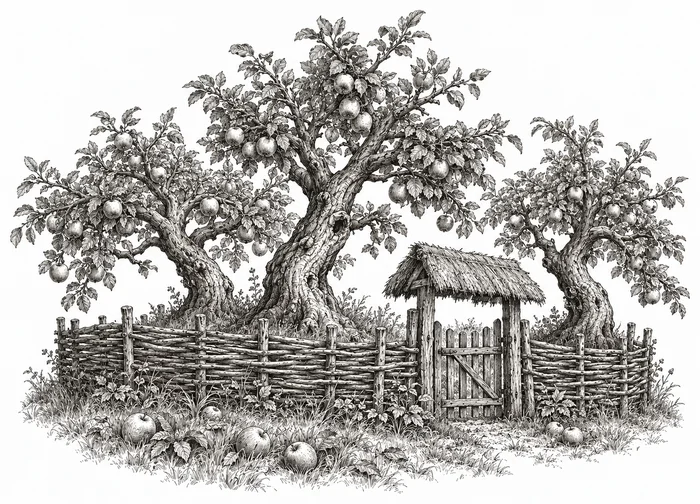
The Old English word æppel, ancestor of modern 'apple', could mean fruit in general as well as the apple specifically, which makes early place names such as 'Appleton' harder to interpret than they first appear. Anglo-Saxon sources refer to an apple-based drink, æppelwīn, that seems to have been a valued rather than everyday beverage, and archaeological and documentary evidence points to orchards being kept before, during and after the conversion to Christianity. Monasteries such as Peterborough and Christ Church, Canterbury, are known to have grown apples, sometimes replacing vineyards as the English climate and monastic economy shifted.
Because æppel could mean fruit generally, place-name and textual evidence for specifically apple orchards is not always conclusive.
The medieval
- 1066 (claimed)
The Conquest and the cider mythDebated
It is often said that cider-making arrived in England with the Norman Conquest of 1066, since the word itself is French in origin and Norman lords certainly brought continental apple varieties and orchard practices with them. But Anglo-Saxon sources already mention an apple drink before 1066, and there is a gap of well over a century between the Conquest and the earliest solid documentary record of cider being made in England. The most defensible view is that the Normans accelerated and commercialised something that already existed in some form, rather than introducing cider from nothing.
The popular 'Normans brought cider' story compresses a much messier and slower process and is not well supported by a clean before/after break in the evidence.
- 1204
Cider recorded as rent at RunhamLikely
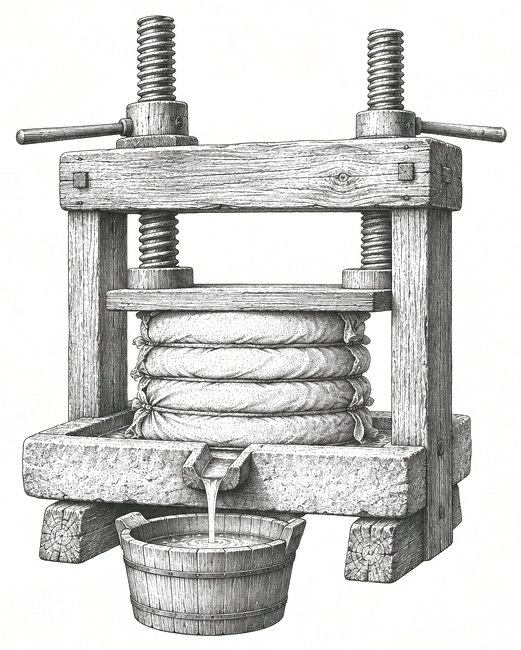
Later cider histories date the first written record of cider paid as rent to 1204, at the manor of Runham in Norfolk, which is said to have owed the Exchequer each year a set quantity of pearmain apples and hogsheads of cider made from them. This is repeated across cider histories as the starting point for firm written evidence of English cider-making, in contrast to the much vaguer Anglo-Saxon and Norman-era references before it. Over the following two centuries, mentions of cider mills, presses and sales become steadily more common in estate records.
The 1204 date is repeated in many cider histories, but they do not quote the original manor record, so treat it as well attested rather than proven.
- 13th century
The word 'cider' arrives in EnglishEstablished
The word 'cider' has a long journey behind it: Hebrew shekar ('strong drink') was rendered into Greek as sikera in the Septuagint, then into Church Latin as sicera, and from there into Old French as sidre or cidre. English borrowed the word from French in the 13th century, first as 'sicer' or 'ciser' in biblical translation meaning any strong drink, not specifically an apple one. Only later, by the 14th century, did the word narrow in English to mean specifically the fermented juice of apples.
The word's meaning was originally broader than 'apple drink' alone, so early uses of 'cider'/'sicer' in English texts cannot automatically be read as referring to what we would call cider today.
- 1292
The Costard, England's first named appleEstablished
The Costard, an all-purpose apple used for cooking and sometimes for cider, is one of the earliest named apple cultivars recorded in English, first recorded as 'Poma Costard' in a fruiterer's bill for Edward I in 1292. It stayed popular for hundreds of years and gave English its word 'costermonger' for a fruit-seller, as well as slang use of 'costard' for a person's head, which Shakespeare plays on in Love's Labour's Lost. Its survival in the language long after the variety itself died out is a useful reminder of how central apples were to ordinary English life.
Tudor England
- c. 1533
New French varieties for the Tudor orchardLikely
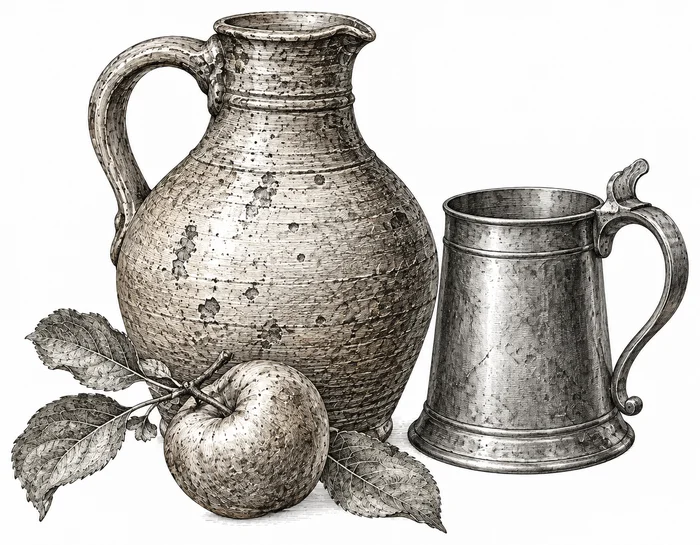
Under Henry VIII, the royal fruiterer brought new dessert and cider apple varieties from France into new orchards planted in Kent, reinvigorating English fruit-growing after a period in which the spread of hop-based beer had dented cider's popularity. Plantings of these French varieties spread over the following decades, through the reigns of Henry's children and beyond, into Gloucestershire, Herefordshire and eastern Wales. This period helped lay the groundwork for the cider counties that would become famous a century later.
The exact date and the fruiterer's specific varieties are known mainly through later horticultural tradition rather than a single well-documented contemporary record.
- 1585
The earliest clearly dated orchard wassailLikely
The historian Ronald Hutton cites a 1585 record from Fordwich in Kent, where the local custom of orchard wassailing was known as 'youling', as the earliest clearly dated description of the practice. An earlier reference to a similar custom, called 'howling', has also been traced to St Albans in Hertfordshire in 1486, so Fordwich is better described as the earliest well-documented example rather than definitively the first ever. Both mark a tradition of singing, drinking and making noise in orchards around Twelfth Night to encourage a good apple harvest.
Fordwich 1585 is the date most often quoted, but an earlier 1486 reference from St Albans means it should not be treated as the single, definite origin point.
The golden age

- 1630s–1660s
Lord Scudamore and the RedstreakLikely
John Scudamore, 1st Viscount Scudamore, developed large-scale cider orcharding at Holme Lacy in Herefordshire from the 1630s, championing a variety known as the Redstreak, sometimes called 'Scudamore's Crab'. Accounts differ on whether he brought the variety back from Normandy or simply promoted one already growing in his orchards, but his cider, sometimes called 'Vin de Scudamore', became famous; a story often told is that King Charles I preferred it to wine. Scudamore's patronage, and that of contemporaries such as John Beale, helped make Herefordshire cider the standard against which all other English cider was judged.
The precise origin story of the Redstreak apple is disputed even in older sources, some crediting Scudamore with importing it and others with simply propagating a local find.
- 1662
Merret describes deliberately sparkling drinksEstablished
On 17 December 1662, the physician Christopher Merret read a paper to the Royal Society, 'Some Observations Concerning the Ordering of Wines', describing how English wine coopers and cider makers deliberately added sugar or molasses before bottling to trigger a second fermentation and produce a 'brisk and sparkling' drink. This is decades before the Benedictine monk Dom Pérignon became associated with Champagne, and Merret's account explicitly links the sparkling technique to cider makers as well as wine merchants. Strong glass, able to hold the pressure of that second fermentation without shattering, was a necessary part of the same story and had been improving in England from earlier in the century.
This shows the documented technique and stronger glass existed in England well before Champagne's association with Dom Pérignon, but 'England invented sparkling wine' overstates a complex, gradual and partly shared European development.
- 1664
Evelyn's Pomona and the Royal Society's cider projectEstablished
In 1664 the Royal Society published John Evelyn's Sylva, a book on forest trees, and it was the first book the Society licensed and published. Bound in with it was Pomona, an appendix on fruit trees and cider-making. The Society had asked Evelyn to edit the cider papers of one of its members, John Beale, for publication alongside his own, and most of the practical cider advice is Beale's: 57 aphorisms in all. Beale later paid to send around 20,000 grafts of Herefordshire apples and pears to growers in Somerset, Devon and Dorset.
- 1676
Worlidge's guide to English cider-makingEstablished
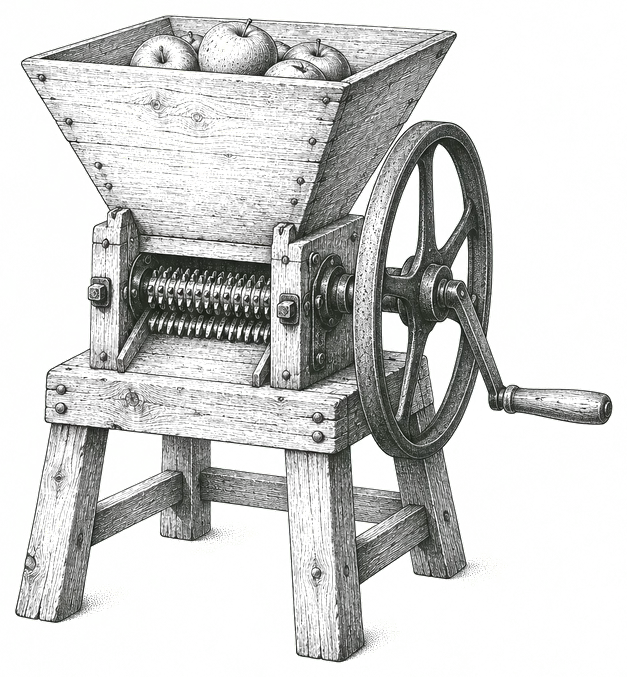
John Worlidge's Vinetum Britannicum, published in 1676, was one of the first books to set out cider-making as a serious, systematic craft suited specifically to England's climate, arguing that cider deserved to be treated as seriously as wine on the continent. It described propagation of fruit trees, storage, pressing methods and a new mill design, and its practical advice changed remarkably little for centuries afterwards. Together with Evelyn's Pomona, it marks the high point of 17th-century English writing about cider as both a craft and a matter of national pride.
The industrial age
- 18th–19th century
Cider as part of a farm worker's wageEstablished
For much of the 18th and 19th centuries, cider was routinely given to farm labourers in the West Country and other cider counties as part or in place of cash wages, with reports of top workers receiving as much as eight pints a day at harvest time. This 'truck' system suited landowners because it used up their own orchard produce, but it also let them under-pay in cash and left workers dependent on the quality, and honesty, of whatever cider they were given. Growing concern about exploitation through payment in goods rather than money eventually fed into wider Victorian labour reform.
The often-quoted 'eight pints a day' figure is a widely repeated example rather than a fixed universal rate; practice varied a great deal between farms and regions.
- 1880
Westons founded at Much MarcleEstablished
Henry Weston founded what became Westons Cider at The Bounds in Much Marcle, Herefordshire, in 1880, building on his existing farming business in the area. The company has remained family-owned and on the same site ever since, making it one of the oldest continuously operating cider makers in England. Its founding sits at the start of a period in which cider-making shifted from a farmhouse and estate activity into an organised industry with national brands.
- 1887
Bulmers founded in HerefordEstablished
H.P. Bulmer was founded in Hereford in 1887 and grew to become the best-known name in English cider, eventually giving the city a museum, a research partnership and a strong association with the drink that persists today. Its rise mirrors that of Westons and other family firms of the same period, as railways, bottling and marketing turned regional farmhouse cider into a national industry. Herefordshire's identity as England's cider county owes a great deal to firms founded in this narrow window at the end of the 19th century.
- 1887
The Truck Act ends wages paid in ciderEstablished
Parliament's Truck Act of 1887 made it illegal to pay a worker's wages, or part of them, in goods such as cider rather than money, aiming to end centuries-old practices that let employers avoid paying properly in cash. In practice the change was slow: farmers protested that giving cider alongside wages, rather than as a substitute for them, was not covered by the Act, and prosecutions for the old practice continued into the early 20th century. The Act is a useful marker of when payment in cider stopped being lawful in principle, even though it did not disappear from farms overnight.
The law changed the practice's legal status, but enforcement was patchy and the custom persisted informally for years afterwards.
- 1903
Science comes to cider: Long AshtonEstablished
Concerned that traditional cider-making methods were falling behind, and prompted by a letter from chemist Frederick Lloyd, the Board of Agriculture convened a conference in Bristol in 1902 that led to the founding of the National Fruit and Cider Institute at Long Ashton, near Bristol, in 1903. Lady Emily Smyth donated land from the Ashton Court estate, and Lloyd became its first director, with the Institute tasked with putting fruit-growing and cider-making on a more scientific footing. It joined the University of Bristol in 1912, was later renamed Long Ashton Research Station, and stayed a leading centre for cider and fruit research through most of the twentieth century.
- 1911
Taunton Cider Company foundedEstablished
The Taunton Cider Company was set up in 1911 at Norton Fitzwarren in Somerset, growing out of an earlier 1805 farmers' cooperative and the cider-making of a local clergyman, whose recipe the new company commercialised. It became a private limited company a decade later and, over the 20th century, grew into one of the best-known English cider brands before passing through several changes of corporate ownership. Its story is typical of how many small West Country cider ventures consolidated into a handful of larger companies across the century.
Decline
- 1950s–2000s
Traditional orchards disappearEstablished
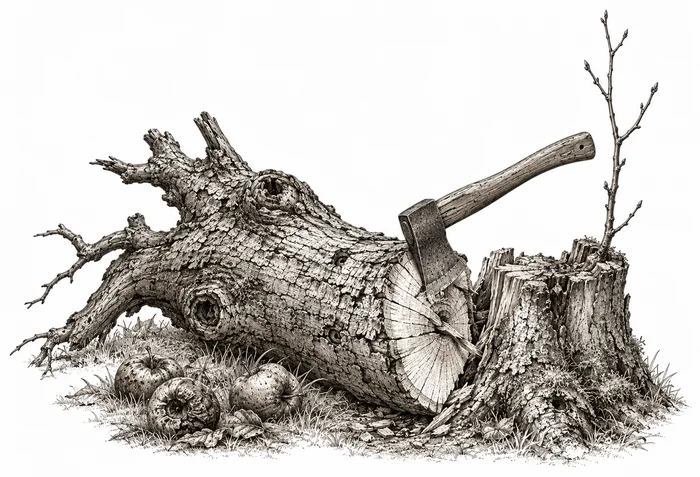
Over the second half of the 20th century, England lost a huge share of its traditional orchards as farming intensified, land was built on, and old varieties were replaced by fewer, more uniform commercial types. Figures differ depending on what is measured and when: some studies cite an area loss of around 60 per cent nationally since 1950, while a later survey by the People's Trust for Endangered Species, part-funded by Natural England, put the loss of individual traditional orchards at around 90 per cent. Both figures point the same way, but the range shows how much the precise number depends on definitions and methodology rather than a single agreed statistic.
The 60 per cent and 90 per cent figures both circulate widely but measure different things (land area versus number of orchards) and come from different surveys, so neither should be treated as the single definitive number.
Revival
- 1985
CAMRA starts campaigning for real ciderEstablished
In 1985, the Campaign for Real Ale extended its brief beyond beer to take up cider and perry, coining the term 'real cider' for drinks made the traditional way, from fresh juice rather than concentrate, without industrial shortcuts. Its APPLE committee went on to run the first National Cider and Perry Championships in 1988, followed by a Pomona Award from 1998 recognising people who had done the most to promote real cider and perry. This gave small and traditional producers a national campaigning voice at a time when the market was dominated by a handful of large industrial brands.
- 21 October 1990
Common Ground launches Apple DayEstablished
The environmental and arts charity Common Ground, founded in 1983, held the first Apple Day in the piazza at Covent Garden in London on 21 October 1990, with around forty stalls of fruit growers, nurseries and cider makers. It was a deliberate response to the huge loss of orchard diversity since the 1950s, meant to reconnect people with local apple varieties and the places they grew. The idea caught on quickly: from around 60 events in 1991, Apple Day celebrations grew to some 300 by 1997 and over 600 by 1999, and it is now often mistaken for a much older folk tradition rather than the recent invention it actually is.
Apple Day is sometimes assumed to be an old country tradition; it is a deliberately created modern event dating only from 1990.
- 2000s–2020s
Craft cider and perry's recoveryLikely
From the 2000s onward, a growing number of small producers across the West Country, Wessex, Herefordshire and beyond have revived traditional bittersweet and bittersharp cider apple varieties and perry pears, often using single-orchard or single-variety approaches similar to wine-making. Perry, long the more obscure relative of cider, has seen a particular revival as growers work to save old perry pear trees, some of which take decades to mature. By the mid-2020s this craft sector sat alongside, rather than replaced, the large industrial brands descended from the Victorian firms, giving British cider a wider range of styles than at any point since the 17th-century golden age.
This is a broad trend covering many small, independent producers rather than a single documented event, so specific figures on the size of the craft sector vary between sources.
What we don't know
When did the cultivated apple reach Britain: before, with, or after the Romans?
The native Malus sylvestris crab apple was already being foraged in Britain thousands of years before the Romans, so wild apples were always present. Grafted, sweet dessert and cider apple varieties were standard across the Roman world by the first century BC, and finds like the Vindolanda supply tablets show Roman Britain valued good apples, which is why most historians think the Romans probably introduced improved cultivated stock and grafting technique. But there is no unambiguous archaeobotanical proof of a Roman-planted orchard surviving in Britain, and the clearest written evidence for organised English apple and cider culture does not appear until the Anglo-Saxon and medieval periods, so a case can also be made that cultivated apple-growing only became well established well after Rome had left.
Is there any truth behind the Julius Caesar 'cider in 55 BC' story?
The story is repeated constantly across cider histories and marketing copy, usually stated as plain fact. But Caesar's own account of the Britons in the Commentarii de Bello Gallico says only that inland tribes lived on milk and meat; it never mentions apples, crab apples, or any fermented drink at all. It remains possible that some fermented crab-apple drink existed in pre-Roman Britain, given that other fermented drinks such as mead and ale certainly did, but this would be speculation from general plausibility, not evidence from Caesar or any other surviving ancient writer.
Did the Normans bring cider to England, or did it already exist?
The word 'cider' does come into English via Norman French, and Norman landowners are credited with bringing continental apple varieties and better pressing methods after 1066. However, Anglo-Saxon sources refer to an apple-based drink, æppelwīn, before the Conquest, which suggests some form of fermented apple drink already existed in England. The gap of well over a century between 1066 and the first solid documentary record of cider-making, at Runham in Norfolk in 1204, makes it hard to say precisely what changed at the Conquest itself, versus what was a longer, slower process of Norman landowners expanding and commercialising an existing practice.
How much of the domestic apple's genome really comes from the European crab apple?
The widely cited 2017 Duan et al. genome study estimated that around 46 per cent of the cultivated apple's genome traces to Malus sieversii in Kazakhstan, about 21 per cent to the European crab apple Malus sylvestris, and left roughly a third of the genome's origin uncertain. Other genomic studies broadly agree that sylvestris made a large secondary contribution, in some cases arguing it was large enough that modern apples are genetically closer to the European crab apple than to sieversii. Because different studies use different sampling, methods and reference genomes, the exact percentages, and precisely when and where the sylvestris introgression happened along the Silk Road, are still being refined rather than settled.
Did English cider and wine makers really invent sparkling wine before Champagne?
Christopher Merret's 1662 paper to the Royal Society clearly documents English wine coopers and cider makers deliberately adding sugar before bottling to induce a second fermentation and a sparkling drink, decades before Dom Pérignon's later association with Champagne. Some cider histories go further and credit Sir Kenelm Digby with inventing the strengthened glass bottle needed to survive that pressure as early as the 1630s. Both claims have real documentary support and predate the traditional French origin story, but 'England invented sparkling wine' oversimplifies a gradual, shared European development in both glassmaking and fermentation technique, and Dom Pérignon's own role in Champagne is itself often mythologised.
Often said, less often true
- Julius Caesar found the Britons drinking cider when he invaded in 55 BC.
Not supported by any surviving ancient source: Caesar's own account of British customs mentions only milk and meat, with no reference to apples or any drink at all, and no other classical writer records it either.
- Cider-making came to England with the Norman Conquest of 1066.
Overstated: an apple-based drink is already mentioned in Anglo-Saxon sources before 1066, and the earliest solid documentary record of English cider-making, at Runham in Norfolk, is not until 1204, so the Conquest is better seen as an accelerator than a starting point.
- The Fordwich, Kent record of 1585 is the first ever orchard wassail.
It is the earliest clearly documented example historians commonly cite, via Ronald Hutton, but an earlier, similar 'howling' custom is recorded at St Albans in 1486, so Fordwich should be read as well-documented rather than definitively first.
- England has lost 90% of its traditional orchards since the 1950s.
This specific figure comes from a PTES survey, part-funded by Natural England, counting individual traditional orchards, and is real; but other reputable sources quote a lower figure of around 60% loss measured by orchard area, so the true picture depends heavily on exactly what is being counted.
- Apple Day is an ancient English folk tradition.
It is a modern invention: the environmental charity Common Ground created it and held the first Apple Day in Covent Garden on 21 October 1990, deliberately in response to post-war orchard loss, not as a revival of a historic festival.